northcell › blog › financial peace
How We Paid Off Our Mortgage Early (and Why I Would Do It Again)
We paid off our mortgage early by budgeting every month, setting money aside for the bills that ambush you, and sending every spare dollar straight at the principal. The day our mortgage balance hit zero, I expected to feel something dramatic. I didn't. What I felt was quiet. The low hum of worry I had carried for years, the one I had stopped even noticing, just switched off. That silence is the real reason I would do it all again.
If you have ever searched whether it is worth paying off your mortgage early, you have probably found a wall of bank pages and calculators arguing about interest rates. I want to give you the other thing those pages never do: an honest, first-person account of what it actually took, what it cost us, and what it felt like on the other side. This is our story, not advice for your situation. The math depends on your numbers, and I will be straight with you about where the math and the feeling pull in different directions.
Key takeaways
- Paying off our mortgage early was never really about the interest math. It was about removing the biggest source of background stress in our lives.
- On paper, investing the extra money instead can win if your mortgage rate is low. A paid-off house is a guaranteed return plus a kind of calm that does not fit in a spreadsheet.
- The thing that made it possible was boring and repeatable: a budget we actually followed, money set aside for the bills that ambush you, and any spare margin sent straight at the principal.
- What changed most was not our income. It was having a system that showed us the whole year instead of just the next paycheck.
Where we started
For years, money was the quiet weight in our house. I earned a good income, but the paycheck would land and somehow be gone by the second week. I wasn't reckless. I just didn't have a system, so the not-knowing followed me everywhere. The idea of paying off a mortgage early would have sounded like a joke. We were busy losing track of money we already had.
The thing that changed it wasn't a raise. It was finally deciding to see the whole picture: every dollar with a plan, money set aside for the bills I knew were coming, and the full year in front of me instead of just the week. Once we paid off our consumer debt and built a little breathing room, the mortgage stopped looking like a fixed fact of life and started looking like the last big thing standing between us and real calm.
Is it worth paying off your mortgage early? The honest answer
| Reasons to pay it off early | Reasons to invest instead |
|---|---|
| A guaranteed return equal to your mortgage interest rate, with no market risk | Over a long horizon, investing the same money may grow to more than the interest you would save |
| Your largest monthly payment disappears, so your margin for error gets huge | Your money stays liquid and accessible, not locked in the walls of your house |
| Real peace of mind: the background worry of owing on your home goes quiet | You keep the mortgage-interest tax treatment and any low fixed rate you locked in |
| Owning your home outright protects you in a job loss or income shock | You can keep building retirement and emergency savings at the same time |
Here is the part most pages skip, so I will say it plainly. If your mortgage rate is low, the spreadsheet often says you would come out ahead investing the extra money rather than throwing it at the house. That is a real argument and I am not going to pretend otherwise. Paying down a mortgage gives you a guaranteed return equal to your interest rate. Investing carries more risk and, over a long enough time, potentially more reward.
So why did we pay it off anyway? Because a paid-off house is not only a financial decision, it is an emotional one, and we were honest about which one we needed more. The guaranteed return was nice. The bigger return was sleeping well and no longer feeling like the house was something we were renting from the bank one payment at a time. For us the calm was worth more than the last sliver of optimized math. For you it might not be, and that is a completely fair call to make differently. Neither answer is wrong. The only mistake is choosing without looking at both sides.
How we actually did it
There was no windfall and no clever trick. It was three unglamorous habits, repeated for longer than felt exciting.
- We budgeted every single month. Not a strict, joyless budget. Just a plan that gave every dollar a job before the month started, so spare money had somewhere intentional to go instead of evaporating.
- We set money aside for the bills that ambush people. Car repairs, insurance, the holidays. When you save a little each month for the costs you can see coming, a surprise stops being an emergency that resets your progress. This is the single habit that kept us moving forward instead of two-steps-forward-one-step-back. It is exactly what a sinking fund does.
- We sent the margin straight at the principal. Whatever the budget freed up in a given month, even small amounts, went onto the loan as extra principal. Early in a mortgage, those extra payments do the most work because they erase future interest, not just the balance. If you are attacking other debt first, our Debt Payoff Planner shows you the order to knock it out and the date you will be free.
None of that requires a high income. It requires seeing your whole year clearly enough to know where the margin is. That visibility is the part the right spreadsheet gives you, and it is the part we did not have for the years we struggled.
What it actually feels like now
The celebration was small. A coffee, a quiet look between my wife and me, and then back to a normal Tuesday. The real change showed up in the weeks after. Our single largest monthly bill was simply gone, which made our margin for error enormous. Decisions I used to make out of fear, staying somewhere because the math said I had to, I could start making out of choice. Not long after, I left a job I no longer needed. We work from home now, raising our two teenagers, with a lot less anxiety in the house. We did not get rich. We got organized, and the organizing bought us out of the stress.
free download
Start where we started: the free Sinking Funds Tracker
The habit that protected our progress was setting money aside for the bills we knew were coming. I built a free starter version of the exact sheet I use with my own family. You list your big irregular bills, it works out the small amount to set aside each month, and it tracks every balance so nothing derails you. Tell me where to send it and it is yours.
The budget that did the quiet work
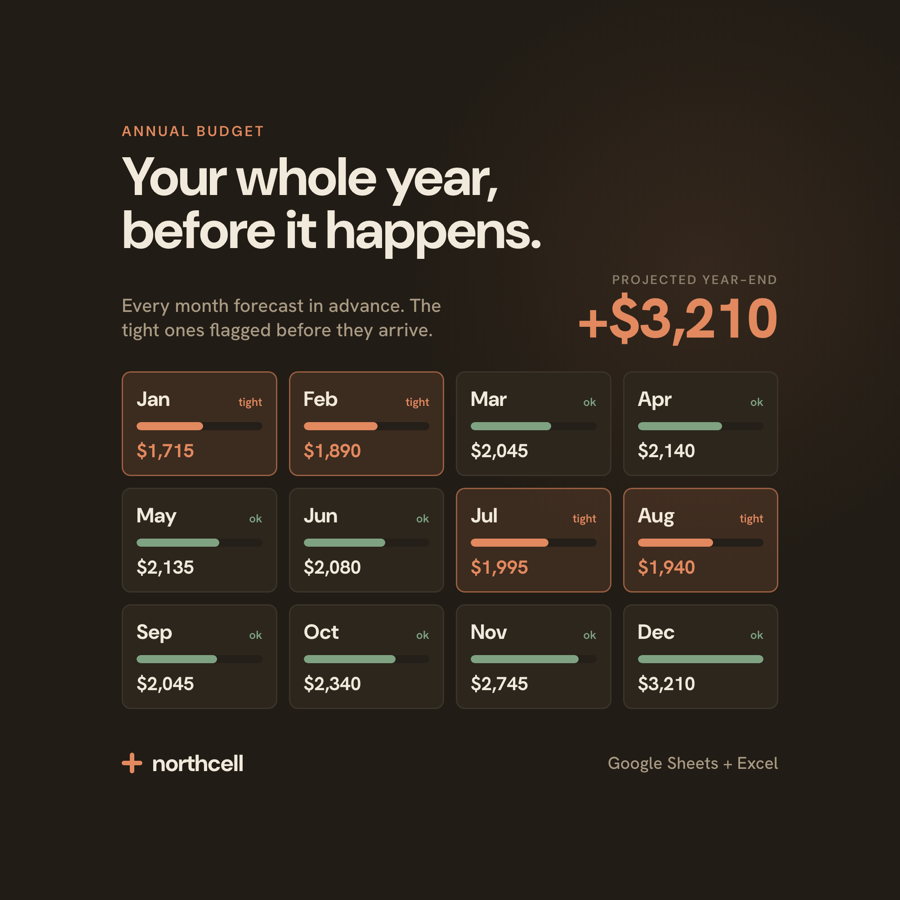
The free tracker handles the set-asides. The thing that actually let us find extra money to throw at the mortgage was seeing the whole year at once: which months would run tight, where the margin was hiding, and what was safe to send at the loan. That is what the northcell Annual Budget does, a full 12-month dashboard with the sinking-fund set-asides built in. It is the same kind of sheet we used, cleaned up and handed to you.
Frequently asked questions
Is it worth paying off your mortgage early?
It depends on what you are optimizing for. On paper, if your mortgage rate is lower than what you could reliably earn elsewhere, the math can favor investing the extra money instead. But a paid-off house is also a guaranteed return and a kind of peace that does not show up in a spreadsheet. For our family the calm was worth more than the last bit of optimized math. Yours may weigh differently, and that is a personal call, not a rule.
Is it better to pay off your mortgage or invest?
The general tradeoff: paying down a mortgage gives you a guaranteed return equal to your interest rate, while investing carries more risk and potentially higher long-run reward. Many people do some of both. The right mix depends on your interest rate, your other debt, your safety net, and how much the monthly payment weighs on you. This is education, not advice for your situation.
Does paying off your mortgage early hurt your credit?
Closing a long-running installment loan can cause a small, temporary dip in your credit score because it changes your credit mix and account age. It is usually minor and short-lived, and owning your home outright is worth far more than a few points. If you plan to apply for other credit soon, just be aware of the timing.
How can I pay off my mortgage faster?
The honest version is unglamorous: build a budget you actually follow, set aside money for the irregular bills so a surprise does not reset your progress, and send whatever margin you find each month straight at the principal. Small, consistent extra payments early in the loan do the most work because they cut future interest.
What does it feel like to be mortgage-free?
Quieter than you expect. The big shift is not the celebration, it is the background worry that finally goes silent. Your largest monthly bill disappears, your margin for error gets huge, and a lot of decisions you used to make out of fear you can start making out of choice.
Related reading
Designed and written by northcell. This is a personal account shared for general education and planning purposes only, not financial, tax, or legal advice; your situation may call for a different choice. Our tools and guides are original works created with AI-assisted design; every formula is human-tested and verified.